
Why Lead Nurturing Automation Is Non-Negotiable in 2026
Most marketing teams already know they should be nurturing leads. The problem is execution. Your sales team can realistically track maybe 30–50 active conversations with any real personalization. Your pipeline has hundreds. The math doesn't work — and that gap is exactly where deals die.
The B2B buying landscape has shifted decisively toward self-directed research. Prospects evaluate your product, compare competitors, and form strong opinions before ever speaking with a human on your team. By the time they're "sales-ready," they've already decided whether you're worth their time. That means the nurturing window — the period before a sales conversation — has become the most important phase of your entire funnel.
The data backs this up: nurtured leads produce 20% more sales opportunities than non-nurtured leads, and when they do convert, they make purchases that are 47% larger on average. That's not marginal improvement — it's a different revenue tier entirely.
The catch is that delivering this level of timely, relevant, personalized engagement at scale is impossible to do manually. Automation isn't a nice-to-have. It's the infrastructure that makes modern lead nurturing function at all.
The 5 Core Lead Nurturing Automation Strategies
1. Behavioral Trigger Sequences
Time-based drip sequences — "send email 3 on day 7" — are a relic. The problem with fixed timelines is that they ignore the most important signal you have: what the prospect is actually doing. Behavioral trigger sequences flip this model entirely.
Instead of waiting for a calendar date, you trigger communications based on specific actions: a prospect visits your pricing page, downloads a case study, watches a product demo video, or opens three emails in a row without clicking. Each of these signals tells you something specific about where that person is in their evaluation, and your automation should respond accordingly.
A pricing page visit at 11pm on a Tuesday tells you something very different than a blog post read. The first deserves an immediate, high-intent follow-up — maybe a personalized "saw you checking out pricing" email with a comparison guide. The second warrants something lower-pressure, like a related educational resource.
Platforms like ActiveCampaign and Customer.io have built their entire architectures around this event-driven model, and it shows in conversion results. Customer.io in particular excels at triggering off custom events from your product database, making it ideal for SaaS companies where in-app behavior is the richest signal available.
2. Multi-Stage Content Progression
Not every lead is ready for the same message. A prospect who found you through a top-of-funnel blog post about "what is marketing automation" needs fundamentally different content than someone who just signed up for a free trial. Treating them the same — blasting the same sequence to both — is the fastest way to waste your automation investment.
Multi-stage content progression maps content assets to specific buying stages and then automates the progression between them. A prospect who consumes your awareness-stage content and engages with it should automatically graduate to consideration-stage content (comparison guides, case studies, ROI calculators) without requiring any manual intervention.
The key is building logical transitions. Each piece of content should have a clear "next step" that advances the prospect further down the funnel while still feeling helpful rather than pushy. If someone reads your "email marketing vs marketing automation" guide, the obvious next asset is a comparison of specific platforms — not a demo request.
3. Lead Scoring and AI-Powered Segmentation
Lead scoring solves one of the most expensive problems in B2B sales: sales teams spending time on leads that will never convert, while truly high-intent prospects don't get enough attention.
Traditional lead scoring was rules-based — assign points for job title, company size, email opens, page visits. Modern implementations layer AI on top of this to identify patterns that human-defined rules miss. AI-powered behavioral segmentation that incorporates real-time actions and engagement depth across all touchpoints delivers 25% conversion increases within six months, according to implementation data from SaaS marketing teams.
Predictive lead scoring — which uses machine learning to score based on similarity to historical converters — delivers an additional 16% improvement in conversion rates by surfacing high-intent prospects who might not match your traditional ideal customer profile on paper but whose behavior pattern matches your best customers.
For B2B SaaS specifically, segment your leads into at minimum three behavioral tiers: high-engagement prospects (multi-page visitors, demo requesters, pricing visitors), mid-funnel evaluators (comparison and feature page visitors), and early-stage researchers (blog and educational content consumers). Each tier should receive distinct nurturing tracks with different cadence, content type, and eventual handoff threshold to sales.
Newsletter
Get the latest SaaS reviews in your inbox
By subscribing, you agree to receive email updates. Unsubscribe any time. Privacy policy.
HubSpot Marketing Hub and Marketo Engage both offer robust lead scoring with CRM integration, which is critical — your scores are useless if they don't inform how sales prioritizes their outreach queue.
4. Multichannel Engagement Workflows
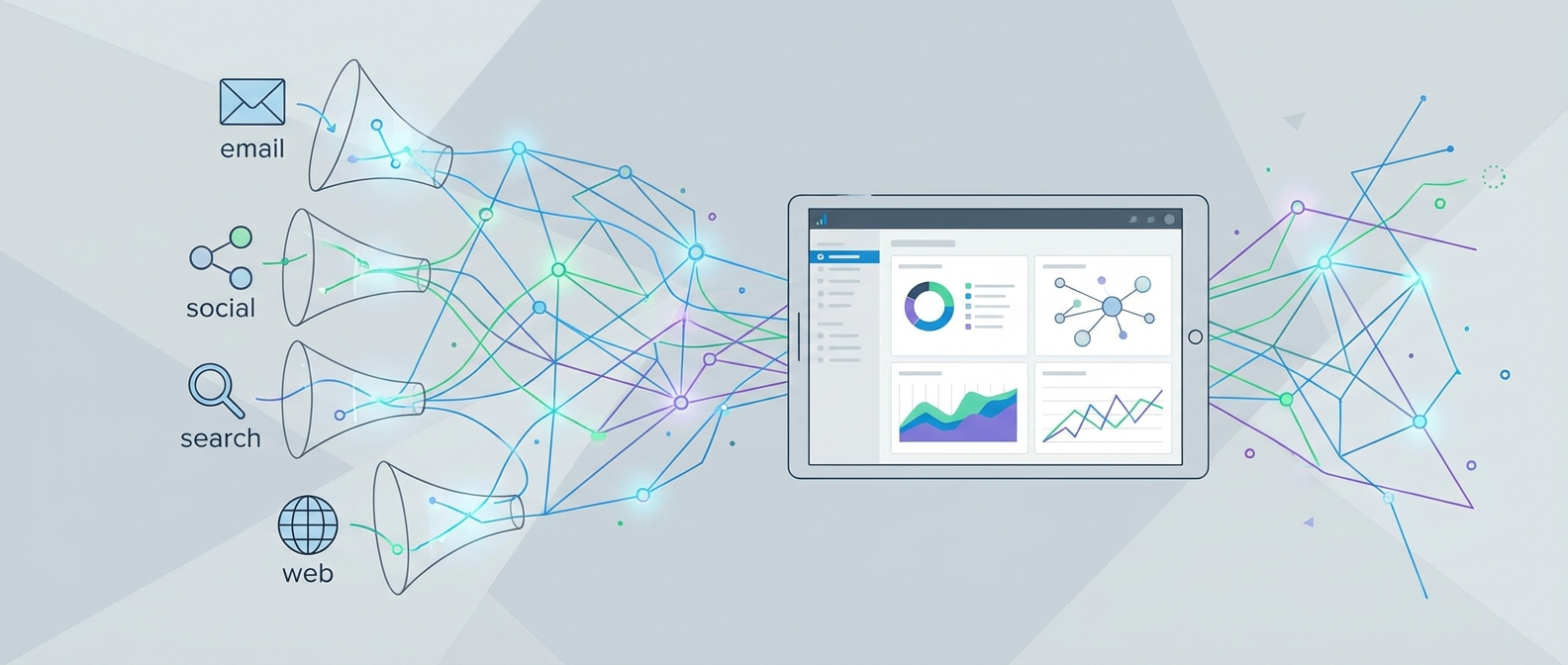
Email is still the workhorse of lead nurturing, but limiting your automation to email alone means you're only reaching prospects when they're in their inbox — which is an increasingly unpredictable time. Multichannel workflows extend your nurturing across the channels where your prospects actually spend time.
LinkedIn retargeting and Google display campaigns coordinated with your email sequences create a surround-sound effect. When a prospect receives your email about a case study and then sees a LinkedIn ad featuring the same customer story the next morning, the compounding effect on recall and trust is significant. Dynamic email drips combined with multi-channel retargeting across LinkedIn and Google generate up to 30x more revenue per recipient compared to single-channel approaches.
The important caveat is coordination. Multichannel doesn't mean blasting the same message everywhere simultaneously — it means orchestrating complementary touchpoints that reinforce each other without becoming overwhelming. Your email, your retargeting ads, your LinkedIn outreach, and any SMS or push notifications should feel like parts of a coherent conversation, not four separate teams all competing for the same attention.
5. AI-Powered Personalization at Scale
The best automation doesn't feel automated. When a prospect receives a message that speaks directly to their situation — their industry, their specific problem, the content they've been consuming — it builds trust in a way that generic sequences never can. AI-powered personalization makes this possible at scale.
Modern platforms can dynamically adjust email subject lines, body copy, content recommendations, and CTAs based on real-time behavioral data. A prospect in the manufacturing sector who's been consuming content about operational efficiency should see different messaging than a SaaS founder focused on user acquisition — even if both are at the same stage in your funnel.
This extends to send-time optimization as well. AI can analyze when each individual prospect is most likely to engage with email and schedule sends accordingly, rather than blasting your entire list at the same time and hoping for the best.
What the Numbers Actually Look Like
| Nurturing Approach | Sales Opportunities Generated | Average Purchase Size | Conversion Rate Lift |
|---|---|---|---|
| No nurturing (manual follow-up only) | Baseline | Baseline | — |
| Basic automated drip sequences | +20% vs. non-nurtured | +47% at conversion | Modest |
| AI behavioral segmentation added | Significant increase | Higher ticket, better fit | +25% within 6 months |
| Predictive lead scoring added | Higher volume, better quality | Consistent with segment fit | +16% additional lift |
| Full multichannel orchestration | Maximum pipeline contribution | Up to 30x revenue per recipient vs. single channel | Highest observed |
These numbers aren't hypothetical benchmarks from analyst reports — they come from documented implementation results across B2B SaaS marketing teams. The compounding effect of stacking strategies is real: each layer you add (behavioral triggers → scoring → multichannel → AI personalization) multiplies the impact of the layers beneath it.
Choosing the Right Platform for Your Nurturing Stack
There's no universally "best" platform for lead nurturing automation — the right choice depends on your team's technical sophistication, your existing CRM, your deal complexity, and your budget. That said, here's an honest framework for thinking through the decision.
For SMBs and Growing Teams
ActiveCampaign and GetResponse both offer strong behavioral automation at accessible price points. ActiveCampaign in particular has an exceptionally powerful visual workflow builder that makes complex conditional logic accessible without requiring developer involvement. If you're building your first serious nurturing infrastructure and don't want to pay enterprise prices to do it, this is where to start.
Brevo deserves mention for teams that need multichannel capability (email + SMS + WhatsApp) without the complexity of an enterprise platform. Its CRM is built-in rather than integrated, which removes an entire category of setup friction for smaller teams.
For Mid-Market and Enterprise B2B
HubSpot Marketing Hub is the dominant choice here for good reason: the CRM is native, the behavioral tracking is comprehensive, and the AI-powered features have matured significantly. The total cost is higher than most alternatives, but the reduction in integration complexity often justifies it for teams with serious pipeline volume.
Marketo Engage remains the standard for enterprise marketing operations teams that need fine-grained control over complex nurturing logic. It's not easy to implement, but for organizations running sophisticated multi-product, multi-segment nurturing programs, the power ceiling is higher than any other platform.
Pardot (Salesforce) is the natural fit for organizations already deep in the Salesforce ecosystem. The Salesforce-native architecture means lead scoring, activity sync, and sales handoff all happen within a single data model — which eliminates the most common breakdown point in nurturing programs: the marketing-to-sales handoff.
For Product-Led and SaaS Teams
Customer.io is purpose-built for this use case. Its event-based architecture means you can trigger nurturing sequences off any product event — trial feature adoption, inactivity thresholds, upgrade page visits — with precision that email-first platforms can't match. If in-app behavior is your richest signal, Customer.io is worth serious consideration.
Implementation Framework: Where to Start
The most common mistake in implementing lead nurturing automation is trying to build everything at once. Teams spend months designing elaborate 12-stage sequences across five channels and then launch a system so complex that no one can maintain or optimize it. Start narrower and go deeper.
Phase 1: Nail the High-Intent Trigger (Week 1–2)
Identify your single highest-intent behavioral signal — pricing page visit, demo request abandonment, trial signup without onboarding completion — and build one excellent automation around it. This single workflow, done well, will outperform a dozen mediocre ones. Measure open rates, click rates, and most importantly conversion to sales conversation. Optimize before expanding.
Phase 2: Build Your Scoring Foundation (Week 3–4)
Implement basic lead scoring tied to your CRM. Define what a "sales-ready" lead looks like in terms of behavioral signals and assign thresholds. Route leads above the threshold to sales automatically. This alone will immediately improve how your sales team spends their time.
Phase 3: Add Content Progression (Month 2)
Map your content library to buying stages and build automated progression between them. Don't create new content — categorize what you have and build the logic that moves prospects through it based on engagement signals.
Phase 4: Expand Channels (Month 3+)
Once your email nurturing is performing well and your scoring is calibrated, layer in retargeting and additional channels. Multichannel only amplifies a strong foundation — it doesn't fix a weak one.
The teams that get the most from lead nurturing automation are not the ones with the most sophisticated tech stacks. They're the ones who understand their buyers deeply, map that understanding into their automation logic, and iterate relentlessly on what the data tells them. The platform matters less than the strategy behind it.