
What Is Marketing Automation? A Plain-English Definition
Marketing automation is the use of software to execute, manage, and optimize repetitive marketing tasks without requiring a human to manually trigger each one. Instead of sending every email by hand, adjusting ad budgets at midnight, or manually segmenting your list before every campaign, automation software does it for you — based on rules, behaviors, and increasingly, AI-driven decisions.
Think of it this way: a customer visits your pricing page three times in one week. Marketing automation notices that signal, scores their intent upward, drops them into a high-consideration nurture sequence, and alerts your sales team — all without anyone lifting a finger. That's the promise, and in 2026, the reality is closer to that promise than it has ever been.
The simplest definition comes from the practice itself: marketing automation replaces manual, time-based tasks with trigger-based, behavior-driven systems that scale without proportional headcount growth. But that undersells what modern platforms can do. Today's tools don't just send emails on a schedule — they orchestrate multi-channel journeys, personalize content at the individual level, and use machine learning to continuously improve performance.
How Marketing Automation Actually Works
Understanding marketing automation means understanding the mechanics underneath. Every automation system — from Mailchimp to enterprise-grade platforms like Marketo Engage — operates on the same fundamental architecture, even if the sophistication varies wildly.
Triggers and Actions
The core building block is a trigger-action pair. A trigger is an event that initiates an automation: a form submission, a page visit, a purchase, a link click, a date, or even the absence of activity (like a contact who hasn't opened an email in 90 days). An action is what the system does in response: send an email, add a tag, update a contact field, notify a salesperson, launch an ad retargeting campaign, or wait a defined number of days before doing the next thing.
Simple automations chain a few of these together. Sophisticated ones branch across dozens of conditions, adapting the path a contact follows based on their real-time behavior.
Segmentation and Personalization
Automation without segmentation is just bulk sending with extra steps. The real leverage comes from using data — purchase history, browsing behavior, demographics, lifecycle stage, engagement patterns — to divide your audience into meaningful segments and deliver content that's actually relevant to each group.
In 2026, the leading platforms don't rely on manually built segments alone. They use AI to create per-contact context profiles: dynamically updated records that factor in behavioral signals, purchase intent, content preferences, and even optimal send times for that specific individual. Klaviyo has been particularly aggressive here, building predictive analytics directly into its segmentation engine for ecommerce brands.
Multi-Channel Orchestration
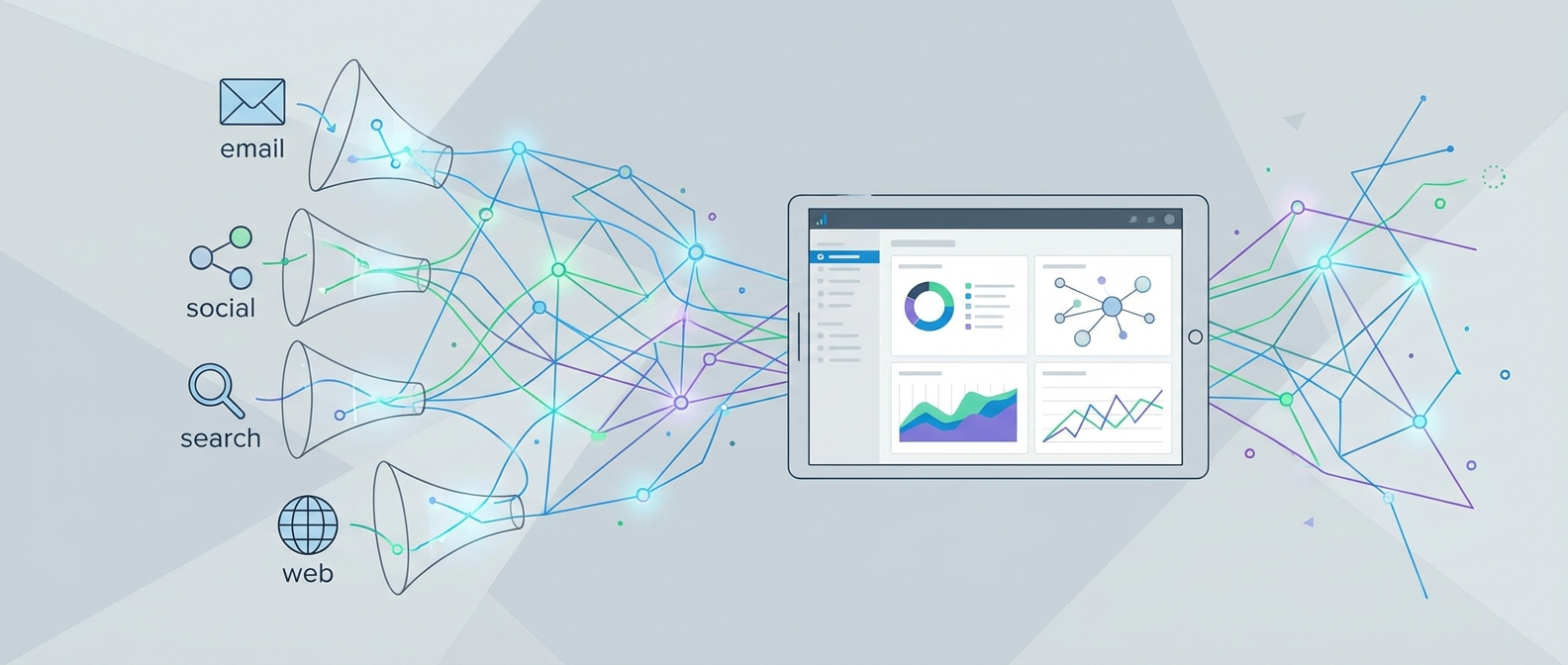
Email remains the backbone, but modern marketing automation spans SMS, push notifications, in-app messages, paid retargeting, social media, and direct mail — sometimes all within a single workflow. The goal is a coherent customer experience regardless of where someone encounters your brand. A contact who ignores your email might respond to an SMS. A prospect who clicks an ad might convert after receiving a personalized onboarding sequence. Orchestration means connecting those dots automatically, not juggling five separate tools.
The Core Use Cases Where Automation Delivers Real ROI
Marketing automation is not a silver bullet — but in specific use cases, the return is hard to argue with. Here's where it consistently earns its keep.
Email Nurture and Drip Sequences
Lead nurturing is the original automation use case and still the most universally applicable. A prospect downloads a white paper, enters a drip sequence, receives progressively more specific content over four weeks, and arrives at a sales conversation already educated. The automation handles the timing, the branching, and the follow-up. Platforms like ActiveCampaign and Drip have built their reputations almost entirely on the quality of their visual workflow builders for exactly this use case.
Lead Scoring and Sales Handoff
Not every lead is ready to buy. Lead scoring assigns numerical weight to actions — visiting the pricing page is worth more than opening a newsletter — and automatically escalates contacts to sales once they cross a threshold. This stops sales teams from chasing cold leads and ensures no hot prospect falls through the cracks. For B2B teams running on Salesforce, Pardot integrates lead scoring directly into the CRM, which is a genuine competitive advantage if Salesforce is already your system of record.
Newsletter
Get the latest SaaS reviews in your inbox
By subscribing, you agree to receive email updates. Unsubscribe any time. Privacy policy.
Ecommerce Lifecycle Automation
Abandoned cart recovery, post-purchase thank-you sequences, win-back campaigns for lapsed customers, cross-sell recommendations based on purchase history — ecommerce automation is a category in itself, and it has some of the clearest attribution data of any marketing channel. Done well, automated abandoned cart emails alone can recover 5–15% of otherwise-lost revenue, depending on timing and copy.
Ad Budget Optimization
Performance advertising is increasingly automated at the platform level — Meta and Google both use algorithmic bidding — but marketing automation adds a layer of control on top. Tools can automatically pause underperforming ad sets, reallocate budget toward winners, and sync CRM data to inform audience targeting. The point is a system that works while you sleep, not one that burns budget because no one noticed the ROAS had collapsed.
Marketing Automation in 2026: What's Actually Changing
The marketing automation landscape is in genuine transition. The category is being reshaped by AI not as a buzzword feature but as a fundamental architectural shift in how these platforms operate.
AI as a Marketing Copilot
If 2025 was the year marketers experimented with AI, 2026 is the year they become expert in it. What began as a tool for generating subject line variations has evolved into a full-scale copilot that can analyze campaign performance, identify segments worth targeting, suggest workflow improvements, and generate content — all within the automation platform itself. The platforms that have integrated AI most deeply are pulling ahead of those treating it as a bolt-on feature.
Reinforcement Learning Closes the Optimization Loop
The most significant technical advance entering mainstream marketing automation is reinforcement learning: systems that don't just execute campaigns but learn from every engagement signal to automatically improve future output. In practical terms, this means a platform can autonomously optimize subject lines, message content, send timing, and offer sequencing — not through a one-time A/B test, but through continuous multi-variable optimization running in the background at all times.
The shift is from A/B testing (which requires human interpretation and action) to self-improving automation that adapts while you're focused on strategy. Early adopters of these capabilities are effectively getting a junior marketing analyst working around the clock at no marginal cost per hour.
Unified Data Becomes the Foundation, Not a Feature
Data silos have historically been the single biggest barrier to effective personalization. A contact might have purchase data in your ecommerce platform, support history in your helpdesk, and engagement data in your email tool — none of which talked to the others. Modern automation platforms are increasingly operating on top of unified data layers that pull from CRM systems, web analytics, advertising platforms, customer service tools, and data enrichment providers simultaneously.
The practical outcome: every contact record now carries richer context — behavioral patterns, frequency preferences, optimal channel timing, intent signals — and the automation engine uses all of it when deciding what to send, when, and where. This isn't a future promise; platforms like HubSpot Marketing Hub have been building toward this model for several years, with their unified CRM-plus-marketing architecture serving as the connective tissue.
Privacy-First Personalization
Stricter regulations, third-party cookie deprecation, and rising consumer expectations around data use are forcing a fundamental rethink of how personalization works. The brands winning in 2026 are those building personalization engines on first-party and zero-party data — information customers actively share — rather than inferred behavioral tracking. This actually plays to marketing automation's strengths: platforms that capture preference data through forms, surveys, and behavioral signals within owned channels are better positioned than those relying on third-party data ecosystems.
Choosing a Marketing Automation Platform: How They Compare
The market spans everything from free entry-level tools to six-figure enterprise contracts. The right choice depends on your business model, technical resources, and where you are in your automation maturity curve. Here's a practical comparison of the major platforms:
| Platform | Best For | Entry Price (mo.) | Standout Strength |
|---|---|---|---|
| Mailchimp | Small businesses, beginners | Free / $13+ | Easiest onboarding; broad integrations |
| Brevo | Budget-conscious SMBs | Free / $25+ | SMS + email in one plan; generous free tier |
| ActiveCampaign | SMBs wanting CRM + automation | $15+ | Best-in-class visual workflow builder |
| GetResponse | Email + landing pages + webinars | $19+ | All-in-one at a mid-market price point |
| Klaviyo | Ecommerce brands | Free / $20+ | Predictive analytics; ecommerce-native segmentation |
| Drip | DTC ecommerce | $39+ | Revenue attribution; deep Shopify integration |
| Customer.io | Product-led SaaS companies | $100+ | Event-driven automation; developer flexibility |
| HubSpot Marketing Hub | Inbound-focused teams | Free / $20+ | Unified CRM + marketing in one platform |
| Marketo Engage | Mid-market and enterprise B2B | $895+ | Deep lead management; enterprise workflow complexity |
| Pardot (Salesforce) | Salesforce-native B2B teams | $1,250+ | Native Salesforce CRM sync; account-based marketing |
A few honest observations from that table: if you're an ecommerce brand, Klaviyo and Drip are purpose-built in ways that general-purpose tools simply aren't — the attribution models and ecommerce-native triggers justify the focus. If you're a B2B company already running on Salesforce, Pardot's tight CRM integration removes friction that would otherwise require custom work. And if you're just starting out, Mailchimp's free tier is a legitimate place to begin — just be aware that you'll likely outgrow its automation capabilities within 12–18 months of serious use.
Is Marketing Automation Worth It for Your Business?
The honest answer: yes, for almost every business that has a repeatable customer journey and more leads or customers than one person can personally manage. The ROI case is clearest in a few scenarios.
If you're running any kind of email list and sending campaigns manually, automation will immediately save time and almost certainly improve results through better timing and segmentation. If you have a sales cycle longer than a few days, lead nurturing automation will reduce the number of prospects who fall through the cracks during the consideration phase. If you're running paid ads, automation that pauses underperformers and reallocates budget prevents the budget bleed that kills campaigns when no one is watching.
What automation won't do is replace strategy. A poorly conceived campaign automated at scale is just a more efficient way to be irrelevant. The teams getting the most from marketing automation are those who combine strong strategic thinking with the operational leverage these tools provide — using automation to execute well-designed journeys faster and more consistently than any manual process could manage.
The trend lines for 2026 point clearly in one direction: automation platforms are getting smarter, more agentic, and better connected to unified data sources. The gap between businesses using these tools well and those managing campaigns manually is going to widen. The question is less "should we automate?" and more "how quickly can we build the data and workflow infrastructure to take advantage of what these platforms can now do?"