
What Omnichannel Marketing Automation Actually Means in 2026
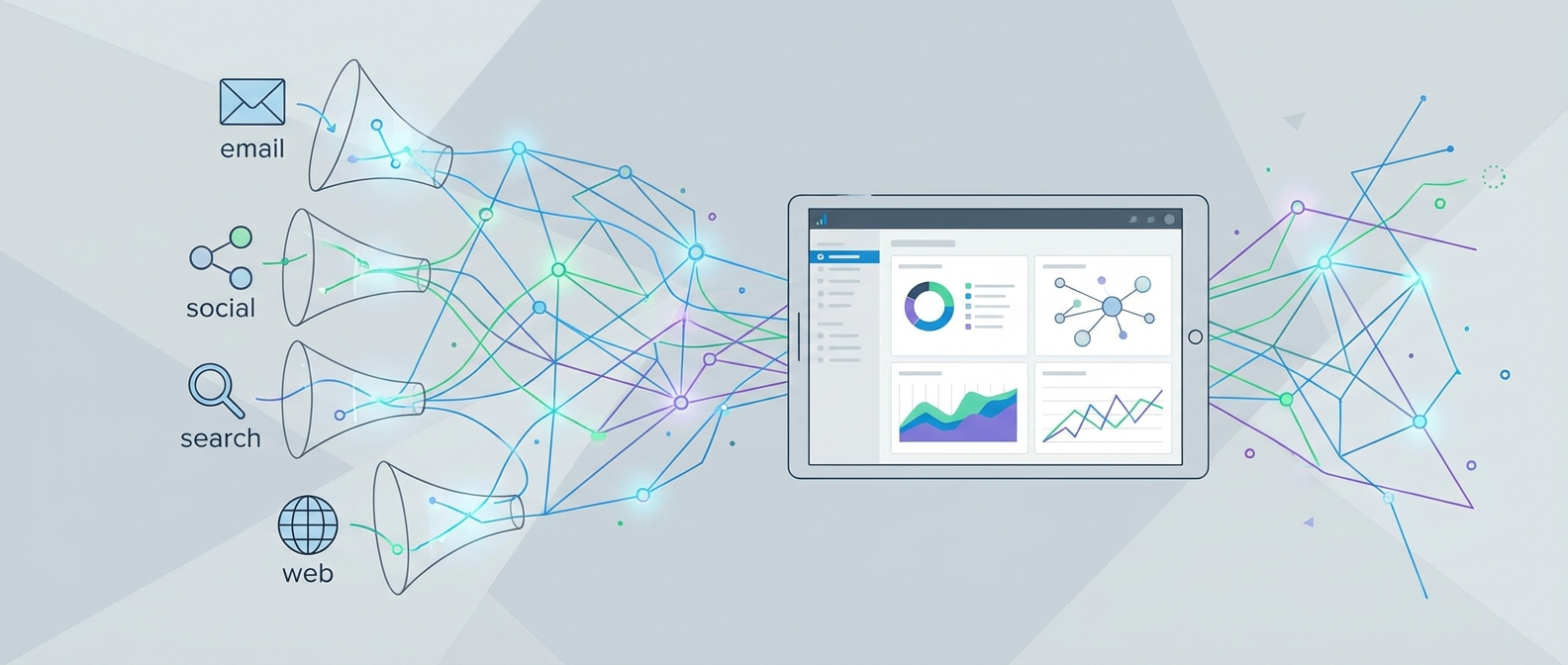
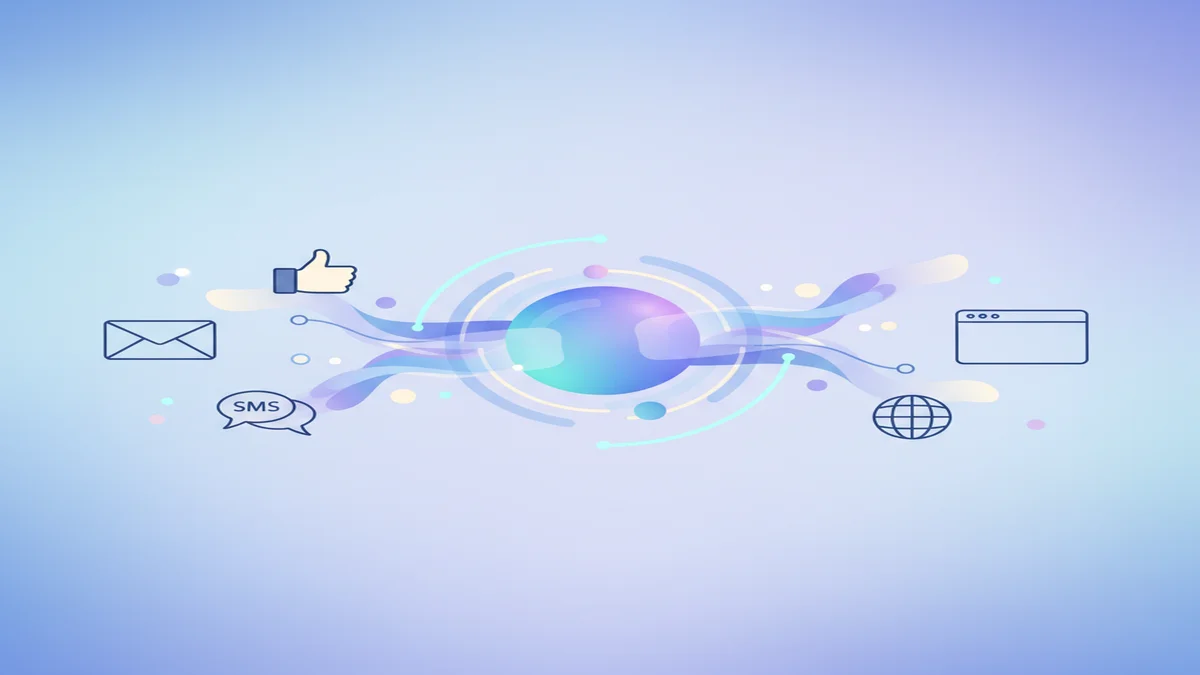
Let's start with a distinction that matters more than most marketers realize. Omnichannel is not the same as multichannel. Multichannel means you show up in multiple places — email, SMS, social ads, a website. Omnichannel means those places talk to each other, share data in real time, and deliver a unified experience regardless of where the customer happens to be.
That gap explains why so many brands invest in "omnichannel" and still see fragmented customer journeys. They've added channels without connecting them. The result: a customer abandons a cart on mobile, gets a welcome email as if they're a brand-new lead, and then sees a paid ad for a product they already bought. Not a good look.
In 2026, omnichannel marketing automation closes that loop. It means a single customer profile — built from web behavior, email engagement, purchase history, and support interactions — drives every automated touchpoint across every channel simultaneously. The automation doesn't just schedule messages; it orchestrates experiences.
And the platforms that enable this have matured significantly. What was once reserved for enterprise brands with seven-figure martech budgets is now accessible to mid-market and even startup-scale teams, particularly through tools like Klaviyo, ActiveCampaign, and HubSpot Marketing Hub.
Why the Business Case for Omnichannel Is Impossible to Ignore
The data on omnichannel performance is not ambiguous. Customers who engage across multiple channels shop 1.7 times more frequently than single-channel shoppers and deliver 30% higher lifetime value. Brands with robust omnichannel engagement retain 89% of their customers, compared to just 33% for brands with weaker cross-channel integration.
Read that last number again. An 89% retention rate versus 33%. That is not a marginal improvement — it is the difference between a sustainable business and a leaky bucket.
The Cost of Staying Siloed
Keeping channels disconnected has a real price tag. When your email team runs on one platform, your SMS on another, and your paid media on a third, you create three problems simultaneously: data inconsistency, message redundancy, and attribution chaos. You end up spending budget on customers who already converted, suppressing the wrong audiences, and making campaign decisions based on incomplete signals.
Automation built on a unified data foundation solves all three. A single customer profile — updated in real time as behavior happens — means every channel is working from the same source of truth. That's what a Customer Data Platform (CDP) provides when it sits at the core of your automation stack.
AI Is Accelerating the Gap Between Leaders and Laggards
If 2025 was the year marketers experimented with AI, 2026 is the year it becomes a full-fledged marketing copilot — one capable of analyzing, planning, and optimizing campaigns automatically. That's not hype; that's the direction every major platform is moving. The brands that build AI into their omnichannel automation now will have a compounding advantage over those still manually segmenting lists and scheduling batch-and-blast sends.
The Core Components of an Omnichannel Automation Stack
Building an omnichannel automation engine doesn't require buying every tool on the market. It requires getting the architecture right. Here are the non-negotiable components.
1. Unified Customer Data Platform
Everything flows from data quality. A CDP aggregates behavioral data — web visits, purchase events, email clicks, support tickets — into a single customer profile. Without this, your automation is firing on incomplete information. Platforms like Klaviyo have built CDP functionality directly into their marketing automation layer, which is a significant operational advantage over assembling a CDP separately and trying to sync it with a separate automation tool.
2. Cross-Channel Journey Orchestration
This is the automation layer itself — the visual workflow builders, trigger logic, and branching conditions that determine what message a customer receives and when. The best platforms let you orchestrate across email, SMS, push notifications, in-app messages, and even direct mail from a single canvas. ActiveCampaign has long been the benchmark for this kind of multi-channel flow complexity at a mid-market price point.
3. Segmentation and Personalization Engine
Relevance is overtaking hyper-personalization as the goal. The distinction matters: hyper-personalization often means using every data point available to create microsegments that are too small to be statistically meaningful. Relevance means sending the right content to a well-defined segment based on genuine behavioral signals. Good segmentation engines support dynamic lists that update automatically as contact properties change — a feature that separates serious automation platforms from basic email tools.
4. Analytics and Attribution
You can't improve what you can't measure across channels. Omnichannel attribution — understanding which combination of touchpoints actually drove a conversion — is one of the hardest problems in marketing and one of the most valuable to solve. Platforms like HubSpot Marketing Hub and Marketo Engage offer multi-touch attribution modeling that gives revenue credit across the full journey rather than defaulting to last-click.
Newsletter
Get the latest SaaS reviews in your inbox
By subscribing, you agree to receive email updates. Unsubscribe any time. Privacy policy.
Platform Comparison: Omnichannel Capabilities at a Glance
Not every platform is built for the same use case. Here's how the leading options compare across the key omnichannel dimensions.
| Platform | Email + SMS | Built-in CDP | AI Automation | Best Fit |
|---|---|---|---|---|
| Klaviyo | Yes | Yes | Yes (predictive analytics, AI flows) | eCommerce brands |
| ActiveCampaign | Yes | Partial (CRM) | Yes (predictive sending, content) | SMB + mid-market |
| HubSpot Marketing Hub | Yes | Yes (native CRM) | Yes (Breeze AI) | B2B inbound teams |
| Marketo Engage | Yes | Via Salesforce/Adobe | Yes (AI-assisted segments) | Enterprise B2B |
| Brevo | Yes | No | Limited | Budget-conscious SMBs |
| GetResponse | Yes | No | Limited | Solopreneurs, creators |
| Customer.io | Yes | Yes (event-based) | Yes (AI branching) | SaaS product teams |
| Drip | Yes (email-first) | Partial | Limited | DTC eCommerce |
The table above reflects capability categories, not a recommendation to pick the one with the most checkmarks. A solopreneur running a content business has no use for enterprise CDP infrastructure. A SaaS company managing a complex free-to-paid conversion funnel needs Customer.io's event-driven architecture far more than it needs a drag-and-drop newsletter builder.
The 2026 Trends Reshaping Omnichannel Automation Strategy
The platforms are evolving fast. Understanding where the category is heading helps you make smarter buying and configuration decisions today.
Autonomous Orchestration Is Moving Beyond Simple If/Then Logic
Traditional marketing automation is rules-based: if a contact does X, send Y. That model still works, but AI-driven orchestration is replacing it at the top of the market. Instead of a marketer manually building every branch, the platform analyzes engagement patterns and dynamically routes contacts through the most likely path to conversion. This is what Klaviyo describes as "autonomous marketing" — and it's becoming a standard expectation rather than a premium differentiator.
Privacy and Consent Are Becoming Personalization Infrastructure
Stricter privacy regulations aren't just a compliance burden — they're reshaping how personalization works. As third-party cookies disappear and consent requirements tighten, first-party data collected with explicit permission becomes the only reliable personalization signal. Brands that built their omnichannel automation on clean, consent-driven data are discovering they have a competitive moat. Those that relied on data aggregators and lookalike audiences are scrambling.
The practical implication: your automation stack needs a consent management layer, and your lead capture flows need to be collecting behavioral preferences, not just email addresses.
Post-Purchase Automation Is the New Retention Battleground
Acquisition costs are rising across every channel. The brands winning in 2026 are investing automation resources in what happens after the first purchase — onboarding sequences, loyalty triggers, reorder reminders, and support-integrated follow-ups. The goal is not just customer satisfaction but measurable retention, because the 89% versus 33% retention gap described above compounds dramatically over a multi-year customer relationship.
This is an area where platforms with native CRM integration — like HubSpot Marketing Hub and Pardot (Salesforce) — have a structural advantage. When marketing automation and customer service data live in the same system, post-purchase automation can trigger off real support events, not just email engagement proxies.
Shoppable Video and Content Commerce Integration
The customer journey in 2026 runs through video. Shoppable video formats on YouTube, Instagram, and TikTok are shortening the path from awareness to purchase, and omnichannel automation needs to account for those touchpoints. The best implementations use UTM parameters and integration events to pull video engagement data into the central customer profile — so a contact who watches 80% of a product video triggers a different automation sequence than one who bounced after five seconds.
How to Audit Your Current Omnichannel Setup
Before buying new technology, it's worth understanding what gaps actually exist in your current stack. A structured audit prevents expensive over-investment in tools that duplicate existing capabilities.
Step 1: Map Your Current Channel Data Flows
Draw (literally, on a whiteboard or in a tool like Miro) every channel you're currently using and ask: does the data from this channel flow back to a central customer profile in real time? If your email platform and your SMS tool are running on separate contact lists with no sync, that's your first gap.
Step 2: Identify Your Trigger Blind Spots
List every high-intent customer action that happens on your properties — a pricing page visit, a cart abandonment, a support ticket opened, a second purchase within 30 days. Then ask: which of these are currently triggering an automated response? Any high-intent signal that gets no automated follow-up is revenue being left on the table.
Step 3: Evaluate Personalization Depth
Pull a sample of 10 recent automated emails your system sent. How many used actual behavioral data — what the contact viewed, bought, or clicked — versus generic demographic segment data? If most of your personalization is limited to first-name tokens and broad list membership, your automation is underperforming relative to what modern platforms can deliver.
Step 4: Assess Attribution Coverage
Can you see, in a single report, which channels contributed to your last 100 conversions? If not, you're flying blind on budget allocation. This is often the forcing function that pushes teams toward a platform consolidation — not because the individual tools are bad, but because fragmented attribution makes strategic decisions impossible.
Choosing the Right Platform: A Framework That Actually Works
Platform selection for omnichannel automation is less about feature matrices and more about fit between your data model and the platform's architecture. Here's the framework we recommend.
Start with your data structure. If your business generates rich event data — SaaS product usage, eCommerce purchase events, app interactions — you need a platform built around event-based profiles, not just contact fields. Customer.io and Klaviyo are architected for this. If your business is simpler — lead generation, nurture sequences, basic segmentation — then ActiveCampaign or GetResponse will serve you well without unnecessary complexity.
Evaluate the integration depth, not just the integration count. A platform advertising 800 integrations means nothing if the integration with your eCommerce store only passes order totals and not individual SKU-level purchase data. The question is not "does it connect?" but "what data does it actually pass?"
Think about where you'll be in 18 months. Migrating automation platforms is painful. Rebuilding flows, re-importing contacts, reconnecting integrations — budget three to six months of disruption for a serious migration. Choose a platform you won't outgrow quickly, and pay particular attention to whether the pricing model scales reasonably with your contact list growth.
The omnichannel automation category has never had more capable tools at more accessible price points than it does in 2026. The brands that win will be those that stop treating channels as separate campaigns and start treating the customer journey as a single, continuously optimizing system — powered by unified data, AI-assisted orchestration, and the kind of post-purchase investment that turns one-time buyers into long-term customers.